Analog Bag
Why Boredom Matters: The Science of the Bored Brain (and What to Do With It)
We treat boredom like a problem to be solved — usually with a phone. But a growing body of research suggests boredom is not the enemy of a good mind; it is one of its quiet engines. Here is what being bored actually does to your brain, and the small analog habit that puts it to work.

Somewhere in the last fifteen years, we quietly abolished boredom. The elevator ride, the checkout line, the ninety seconds waiting for the kettle — every one of those little gaps now has a phone in it. We didn't decide to do this; we just stopped ever being alone with an empty minute.
It feels like a win. It probably isn't.
Because boredom, it turns out, is not a malfunction. It is a signal — and a surprisingly useful one. In one now-famous experiment, people who were first made to do something mind-numbingly dull went on to be measurably more creative than people who weren't. Neuroscientists have watched the bored, wandering brain switch on a network that stitches together memories, plans, and half-formed ideas in a way the focused, scrolling brain simply cannot. Psychologists who study emotions have started calling boredom one of the most misunderstood feelings we have.
This piece is about what boredom is for — the actual science, with the studies named and linked so you can check them yourself. And because knowing is only half of it, each section ends with the same small, unglamorous fix: not another app to manage your screen time, but something to do with your hands the next time an empty minute shows up.
Boredom Is a Signal, Not a Flaw
Start with the reframe, because everything else depends on it: boredom is an emotion, and like every emotion it is telling you something. Dr. Sandi Mann, a psychologist at the University of Central Lancashire who has spent decades studying it, defines it precisely: "Boredom is not the result of having nothing to do, but rather of having nothing to do that appeals at that time." That distinction matters. Boredom isn't emptiness — it's a mismatch between the stimulation you have and the stimulation you want. It's your mind flagging that the current situation is under-engaging and nudging you to go find, or make, something more interesting. Historically that nudge is where a lot of human invention came from. The problem with a phone is that it answers the nudge instantly and cheaply, with an endless feed of just-enough novelty — so the signal fires, gets satisfied in three seconds, and never does the work it was meant to do. Mann's own research found that boredom is one of the emotions we're most eager to suppress, ranking it among the least socially acceptable feelings to admit to. We treat it as a small emergency. The first step to using boredom is to stop treating it as one.
What boredom is actually doing
- Flagging a mismatch between the stimulation you have and the stimulation you want
- Nudging you to seek — or create — something more engaging
- Freeing attention that a task was holding hostage
- Acting as the on-ramp to mind-wandering, where the interesting things happen
The reframe in practice
Next time boredom shows up, try naming it instead of numbing it: "I'm bored" rather than reaching for the phone on reflex. That two-second pause is the whole ballgame — it's the difference between the signal getting hijacked and the signal getting used.
The Experiment: Bored People Were More Creative
This is the study everyone cites, and for good reason. In 2014, Sandi Mann and her student Rebekah Cadman published "Does Being Bored Make Us More Creative?" in the Creativity Research Journal. The setup was almost comically simple. They took 40 people and had them do something genuinely tedious first: copying numbers out of a telephone directory by hand. Then everyone — the bored group plus a 40-person control who skipped the phone book — was given a creative task: come up with as many uses as you can for two ordinary plastic cups. The bored group won. Having marinated in tedium first, they produced more and more inventive ideas than the people who went in fresh. Mann ran a follow-up that sharpened the point. A reading-based boring task produced even more creativity than a writing-based one. Her explanation: reading leaves your mind free to wander, while writing keeps it occupied. "When we are bored, we become more creative," as Mann put it. "If you are not able to satisfy the search for neural stimulation externally, then you tend to go off into your own mind and look for connections." Boredom, in other words, doesn't create ideas directly. It clears the runway for the daydreaming that does.
What the study found
- 40 people who first did a boring task (copying phone numbers) out-created a 40-person control group
- The measure was divergent thinking: unusual uses for two plastic cups
- A passive boring task (reading) boosted creativity more than an active one (writing)
- Daydreaming was the mechanism — boredom's job is to make room for it
Why this points to analog
The takeaway isn't "seek out tedium." It's that the low-stimulation, hands-busy-mind-free state — coloring, doodling, shelling peas — is the same fertile ground the phone book created in the lab. A feed is high-stimulation and mind-occupied: the exact opposite conditions.
Meet the Default Mode Network — Your Brain's Idle Engine
Here's what's happening under the hood. When you stop focusing on a task and let your attention drift, your brain doesn't power down. It switches over to a system neuroscientists call the default mode network — the circuitry that comes online precisely when you're not concentrating on the outside world. This is not a rare state. Researchers estimate we spend as much as 50% of our waking hours with our minds wandering, and the default mode network is what's running the show during those stretches. Far from idle, it's doing some of the brain's most distinctly human work: replaying memories, imagining the future, taking other people's perspectives, and — critically — connecting ideas that live in different mental drawers. Journalist Manoush Zomorodi, whose 2017 TED talk popularized this research, describes it as the brain's "autobiographical planning": knitting the scattered pieces of your life into a story and quietly setting goals from it. Creativity researchers have since shown the link is causal, not just coincidental: when they temporarily dampened default-network regions in the lab, people's ideas got measurably less original. The daydreaming network isn't a bug in an otherwise productive brain. On the evidence, it's where a lot of originality is manufactured — and it only clocks in when you give it a boring, unfocused moment to do so.
What the default mode network does when you drift
- Activates when you stop focusing on external tasks — including when you're bored
- Runs during the ~50% of waking time our minds spend wandering
- Connects distant, unrelated ideas — the raw material of insight
- Handles 'autobiographical planning': turning your life into a narrative and setting goals
How to invite it in
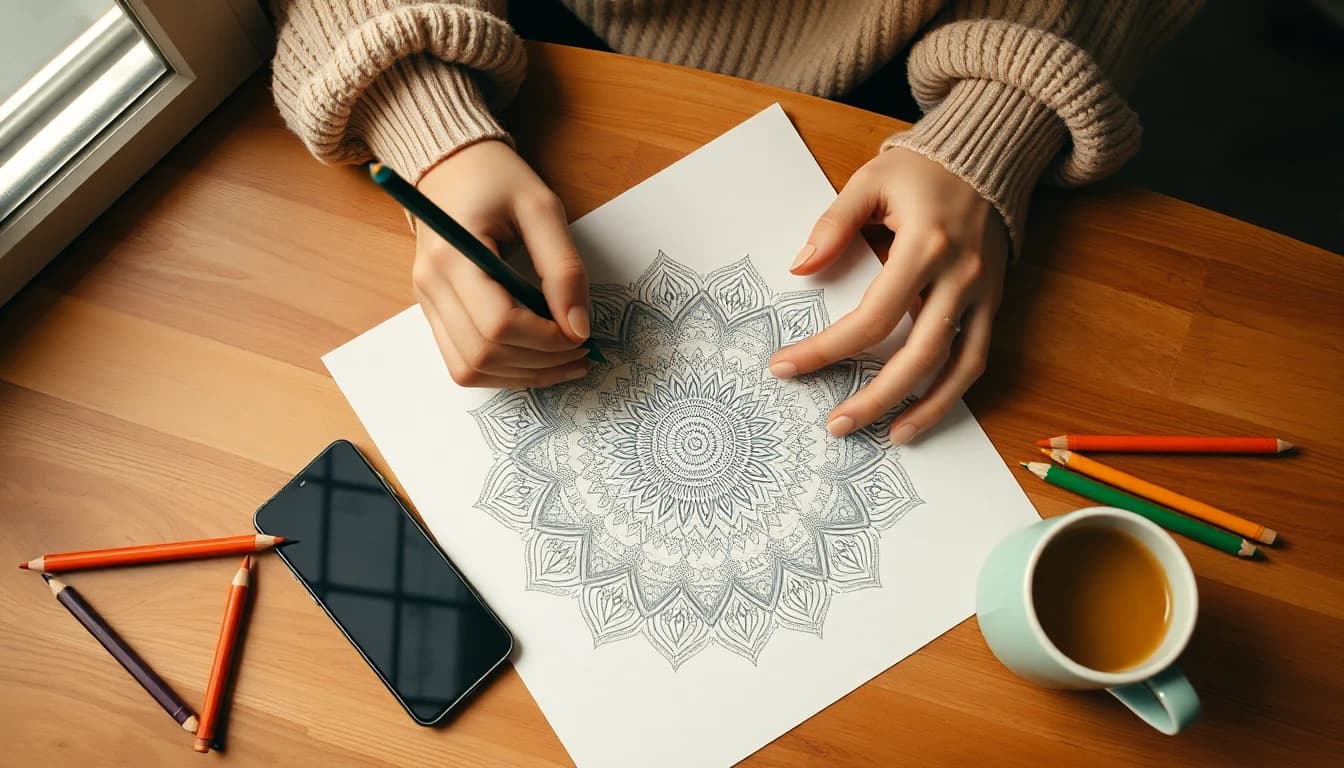
You can't force the default mode network on, but you can invite it: pick an activity that occupies your hands and eyes just enough to keep the phone away, while leaving your thoughts loose. Coloring a mandala, walking without headphones, or filling in a Sudoku grid all fit.
Why Kids Especially Need to Be Bored
If boredom is where the imagination gets exercised, then a childhood with no boredom in it is a problem — and this is where the research gets pointed. Dr. Teresa Belton, a fellow at the University of East Anglia who studies boredom and children, has argued to the BBC that boredom is essential for developing what she calls the "internal stimulus" that fuels genuine creativity. A child who is never bored, whose every gap is filled by a screen, never has to build that muscle. The logic is intuitive once you see it. Boredom is uncomfortable, and a child reaching to relieve it with their own resources — inventing a game, telling a story, making something out of the recycling bin — is doing exactly the improvisational, self-directed work that creativity is made of. Hand them a tablet instead and the discomfort vanishes, but so does the exercise. As Belton puts it, "filling a child's time for them teaches nothing but dependence on external stimuli." The capacity for internally generated stimulation is a skill, and like any skill it only develops through use. This reframes a familiar parenting worry. The kid slumped on the couch sighing "I'm booooored" is not a situation to be fixed. It's the beginning of the most valuable thing a rainy afternoon can offer: the moment right before they figure out what to do with themselves.
What boredom builds in kids
- The 'internal stimulus' Teresa Belton identifies as the root of real creativity
- Self-direction: deciding what to do without being handed the answer
- Improvisation and imaginative play, the core skills of creative thinking
- Tolerance for discomfort instead of instant relief from a screen
| When a kid says 'I'm bored' | The reflex | The better move |
|---|---|---|
| In the car or a waiting room | Hand over a phone or tablet | A pouch of coloring pages and crayons |
| A long, unstructured afternoon | Queue up another show | A pile of paper, markers, and 'figure it out' |
| 'There's nothing to do' | Solve it for them | Leave the boredom — and let them solve it |
For parents
You don't have to engineer boredom, just stop preventing it. Leave a few unscheduled hours with analog supplies within reach and nothing pre-decided. The 'I'm bored' complaint usually resolves itself within minutes — into something they invented.
Turning the Empty Minute Into Something With Your Hands
So the research lands on a slightly awkward conclusion: the most useful thing you can do with boredom is almost nothing — but not quite nothing, and definitely not scrolling. You want the low-stimulation, mind-loose state the phone book created in Mann's lab, without the tedium of an actual phone book. The sweet spot is an activity that keeps your hands occupied and your thoughts free. That's the entire reason a bag of analog things works. A coloring page asks just enough of your attention to keep you off your phone, while leaving your mind wide open to wander — the exact conditions the default mode network needs. A Sudoku grid gives a bored moment a shape and a finish line, where a feed offers neither. Knitting, doodling, a jigsaw on the kitchen table: none of them are productivity hacks, and that's the point. They're structured ways of being pleasantly, usefully bored. Mann calls the goal a "sweet spot" of boredom — "not too little, not too much." The aim was never to eliminate boredom (we already tried that, with the phone, and it cost us the good part). The aim is to meet the empty minute with something better than a screen. Keep one such thing physically closer than your phone, and you've done the only thing that reliably works: made the better option the easier one to reach.
What makes an activity 'usefully boring'
- Occupies your hands and eyes just enough to keep the phone down
- Leaves your mind free to wander instead of feeding it constant novelty
- Has a natural endpoint (a finished page, a solved grid) — unlike an infinite feed
- Requires no signup, no battery, and no notifications
| The empty minute | Scrolling gives you | An analog thing gives you |
|---|---|---|
| Stimulation level | High and relentless | Low and calm — room to think |
| Your mind | Occupied by the feed | Free to wander and connect ideas |
| The ending | There isn't one | A finished page or solved puzzle |
| After you stop | Vaguely depleted | Settled, sometimes with an idea |
One small setup
Build a tiny 'boredom kit': a few folded coloring pages, a couple of printed puzzles, a pen, in a pouch that lives in your bag. Because it only comes out in the dull moments, it stays a small treat — and it turns the exact situations you'd normally scroll through into the ones your mind gets to use.
Final Thoughts
The case for boredom isn't nostalgia, and it isn't anti-technology. It's that we removed something from our days without noticing what it did for us. Boredom was never wasted time — it was the signal that started mind-wandering, the on-switch for the brain's most inventive network, the discomfort that taught kids to entertain themselves. Trading all of it for a feed of frictionless novelty was a worse deal than it looked.
The fix is not to suffer more or throw away your phone. It's smaller than that. The next time you catch an empty minute — in a line, on the couch, waiting for the kettle — let it be a little boring, and reach for something with your hands instead of something with a screen. That's the whole practice.
Everything we make at Analog Bag — the free coloring pages and printable puzzles — exists for exactly that minute. Not to fill it, but to give your mind somewhere better to go.
Get More Screen-Free Ideas
Join our newsletter for weekly analog activity ideas, free printables, and mindful inspiration.
No spam. Unsubscribe anytime.
Sources
- Mann, S. & Cadman, R. (2014). Does Being Bored Make Us More Creative? — Creativity Research Journal, 26(2)
- INTHEBLACK — Why boredom 'can be beautiful' (interview with Dr. Sandi Mann)
- Stanford Wu Tsai Neurosciences Institute — Why do our minds wander? The brain's default mode
- Manoush Zomorodi — How Boredom Can Lead to Your Most Brilliant Ideas (TED, 2017)
- Greater Good Magazine (UC Berkeley) — What Happens When We Shield Kids From Boredom (Teresa Belton)