 Analog Bag
Average Screen Time by Age (2026): The Data, and What to Reach for Instead
The average toddler logs just over an hour of screen time a day. By the teen years that number climbs to 8 hours and 39 minutes. Here is what the data actually says, age by age — and one screen-free thing worth reaching for at every stage.

Most of us have a number we would rather not look at. Your phone keeps one — that weekly screen-time average that quietly resets every Sunday. But how does yours compare to everyone else's, and how does the average change across a lifetime, from a toddler in a high chair to an adult on a lunch break?
This is the data, pulled from the most credible sources available: the Common Sense Media census, the CDC's National Center for Health Statistics, and DataReportal's global digital report. It is organized the way it actually matters — by age — because a healthy number for a 2-year-old and a realistic number for an adult are nothing alike.
There is also a second column to this story that the usual statistics pages leave out. Knowing the average is only half useful; the harder question is what you reach for instead. So next to each age group you will find one simple, screen-free option that fits that stage. None of them require a subscription, and most fit in a bag.
Screen Time by Age, at a Glance
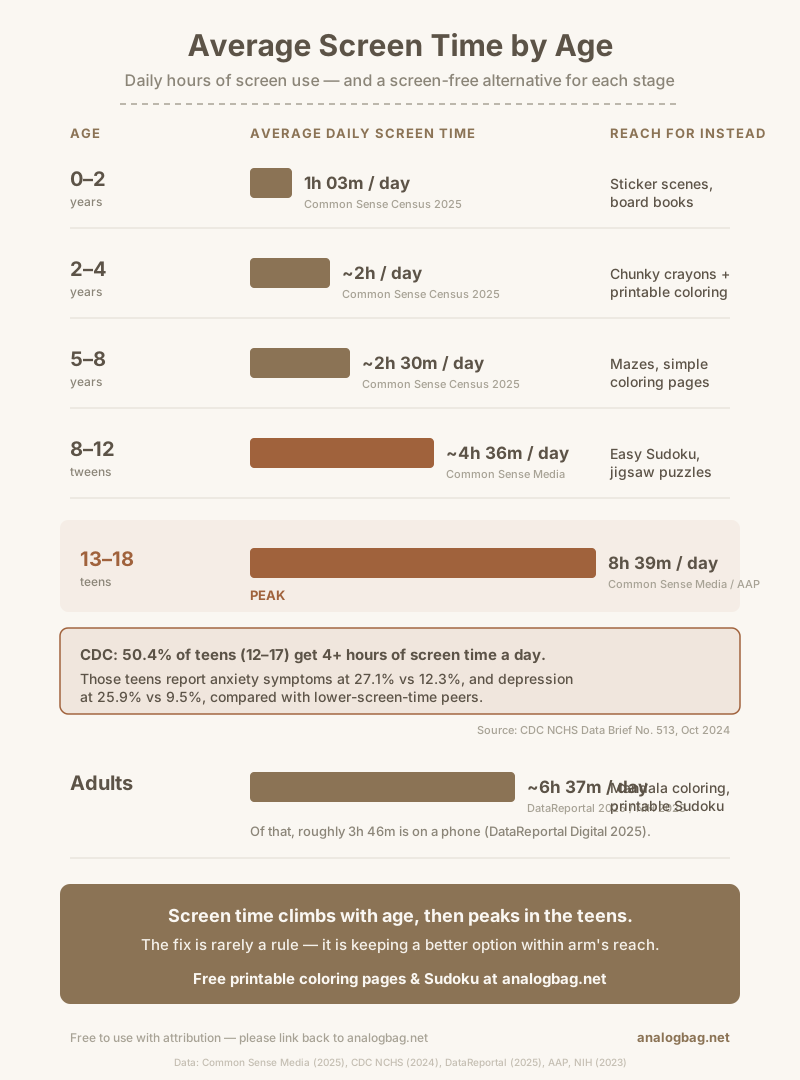
Before the breakdown, here is the whole arc in one image. Screen time starts low in the first years of life, climbs steadily through childhood, spikes sharply in the teen years, and settles into a high but slightly lower plateau in adulthood. The shape of that curve is the real story. It is not that screens are uniquely bad for any one age — it is that the habit compounds. Each stage hands the next a slightly higher baseline. Seeing it laid out tends to make the goal obvious: you are not trying to hit zero, you are trying to bend the curve down a little at whatever stage you are in. The chart below is free to use — if it is helpful for your own article or classroom, please link back to analogbag.net.
Toddlers and Preschoolers (Ages 0–4): About 1 to 2 Hours a Day
Childhood screen time starts earlier than most parents expect. According to the 2025 Common Sense Census on media use by kids zero to eight, children under 2 average 1 hour and 3 minutes of screen time a day, and 2- to 4-year-olds climb to roughly 2 hours. Forty percent of children have their own tablet by age 2. The census also found that across the under-8 group, daily screen time has held steady at about 2.5 hours — but how it is used has shifted, with gaming time up 65% in four years and short-form video on the rise. For this age, the American Academy of Pediatrics points to consistency and co-use mattering more than chasing a perfect number. The good news is that this is the easiest stage to swap. A toddler does not need an algorithm; they need their hands busy. A pouch of chunky crayons and a few printed pages buys the same fifteen quiet minutes a video does — without the wind-up afterward.
What the data says (0–4)
- Under 2 years: 1 hour 3 minutes per day on average (Common Sense Census 2025)
- Ages 2–4: roughly 2 hours per day
- 40% of children have their own tablet by age 2
- Gaming time among under-8s rose 65% in four years
| Instead of a screen | Try this | Why it works |
|---|---|---|
| Handing over a phone in a waiting room | A few printable coloring pages + crayons | Keeps small hands busy, no wind-down crash |
| A tablet during dinner prep | Sticker scenes or a chunky puzzle | Builds fine-motor focus, travels in a bag |
One small swap
Keep a zip pouch with crayons and four or five folded coloring pages in your bag. Because it only appears in meltdown moments, it actually feels like a treat — and it works just as well at age 2 as it does at 6.
School-Age Kids and Tweens (Ages 5–12): 2.5 to 4.6 Hours a Day
As kids enter school, screen time splits into two worlds — school-issued devices and personal entertainment. The numbers here refer to non-school recreational use. Younger school-age children (5–8) sit around 2.5 hours a day, and by the tween years (8–12), recreational screen time rises to roughly 4 hours and 36 minutes, according to Common Sense Media. This is the stage where a child's own taste kicks in, which is exactly why a finishable, analog challenge lands so well. A scrolling feed never resolves — there is always one more video. A puzzle ends. That small hit of I did it is something a screen is structurally unable to give, and tweens feel the difference even if they cannot name it.
What the data says (5–12)
- Ages 5–8: about 2.5 hours per day of recreational screen time
- Tweens (8–12): roughly 4 hours 36 minutes per day
- These figures exclude school-assigned device time
| Instead of a screen | Try this | Why it works |
|---|---|---|
| After-school tablet time | An easy Sudoku or a printed maze | A clear, finishable goal — a feed never ends |
| Screens in the car or waiting | A jigsaw or pencil puzzle | Portable, quiet, and genuinely absorbing |
One small swap
Print a small stack of easy Sudoku or mazes and leave them where the after-school tablet usually lives. Proximity does most of the work — the better option just has to be the closer one.
Teenagers (Ages 13–18): The Peak — 8 Hours 39 Minutes a Day
This is where the curve spikes. U.S. teens aged 13–18 average 8 hours and 39 minutes of screen media a day for non-school use, per Common Sense Media — more than a full-time job. The CDC puts hard numbers on the risk. In its 2024 data brief, 50.4% of teens aged 12–17 reported 4 or more hours of daily screen time, rising from 45.6% of 12–14-year-olds to 55% of 15–17-year-olds. The mental-health correlation is the part editors and parents quote most: teens with 4+ hours of daily screen time reported anxiety symptoms at 27.1% versus 12.3% for lower-screen peers, and depression symptoms at 25.9% versus 9.5%. No coloring page competes with a phone for a 16-year-old, and pretending otherwise is not honest. What does work at this age is a shared, low-pressure analog ritual — a puzzle left on the kitchen table, a coloring book that lives next to the couch — that lowers the friction of choosing something else for twenty minutes.
What the data says (13–18)
- Teens average 8 hours 39 minutes of daily screen media (Common Sense Media)
- 50.4% of 12–17-year-olds get 4+ hours a day (CDC, 2024)
- 15–17-year-olds (55%) exceed 12–14-year-olds (45.6%)
- 4+ hours/day links to higher anxiety (27.1% vs 12.3%) and depression (25.9% vs 9.5%) symptoms
| Instead of a screen | Try this | Why it works |
|---|---|---|
| Doom-scrolling before bed | A medium Sudoku at the kitchen table | Engages focus without the pre-sleep stimulation |
| A phone as the default downtime | A shared coloring book left in reach | Low-pressure, social, no rule to enforce |
One small swap
Aim to bend the number, not erase it. Trading even one of those daily hours for something analog is a meaningful shift at this age — and it is far more sustainable than a blanket ban.
Adults: About 6 Hours 37 Minutes a Day
Adults are not exempt — we just stopped tracking it as a problem. The global average sits at roughly 6 hours and 37 minutes of screen time a day, according to DataReportal's 2025 report and a 2023 analysis published through the NIH. Of that, about 3 hours and 46 minutes happens on a phone. That number is the one your kids are watching most closely. The Common Sense research is consistent on this point: a parent's own habits set the household baseline. The most effective screen-time intervention for a child is often an adult modeling a different default — reaching for something with their hands instead of their feed during the quiet ten minutes that used to belong to the phone. For adults, the analog swap that sticks tends to be the meditative kind: a mandala coloring page or a Sudoku grid that occupies just enough of your attention to keep you off the phone, without feeling like a chore.
What the data says (adults)
- Global average: ~6 hours 37 minutes per day (DataReportal 2025 / NIH 2023)
- Of that, ~3 hours 46 minutes is on a mobile phone
- Parental screen habits strongly shape a child's baseline
| Instead of a screen | Try this | Why it works |
|---|---|---|
| Reaching for your phone in a quiet moment | A mandala coloring page | Meditative focus, sets a model for kids |
| Scrolling on a lunch break | A printable Sudoku | Self-contained, no notifications, real reset |
One small swap
Keep one analog thing on the kitchen counter where your phone usually lands. The swap that works is rarely willpower — it is just keeping a better option physically within reach.
Final Thoughts
Read across the ages and a single pattern emerges: screen time is not a fixed trait, it is a default. It climbs because each stage inherits a slightly higher baseline from the one before, and it bends back down the same way — one small, deliberate swap at a time.
You do not need a system or a strict rule. Pick the number that matches your stage, then pick the one screen-free option next to it, and put that option somewhere you will actually see it. The data is sobering, but the fix is unglamorous and entirely doable: make the better choice the closer one.
Everything we make at Analog Bag — the coloring pages and printable Sudoku — is free, needs no signup, and exists for exactly this purpose: to be the thing you reach for instead.
Get More Screen-Free Ideas
Join our newsletter for weekly analog activity ideas, free printables, and mindful inspiration.
No spam. Unsubscribe anytime.
Sources
- Common Sense Media — The 2025 Common Sense Census: Media Use by Kids Zero to Eight
- CDC NCHS — Daily Screen Time Among Teenagers, Data Brief No. 513 (Oct 2024)
- DataReportal — Digital 2025: Global Overview Report
- American Academy of Pediatrics — Average Amount of Screen Time for Children and Young Adults


