Analog Bag
12 Free Printable Animal Word Search Puzzles (PDF)
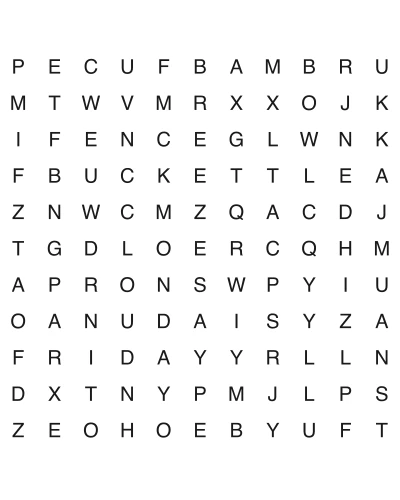
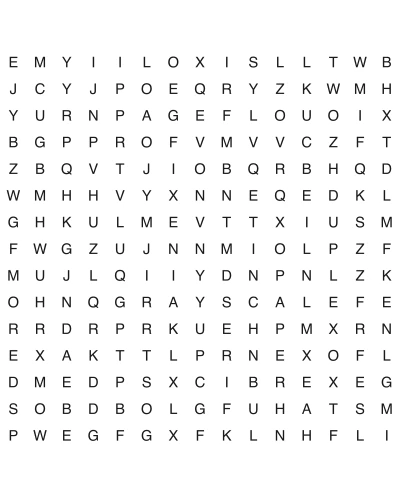
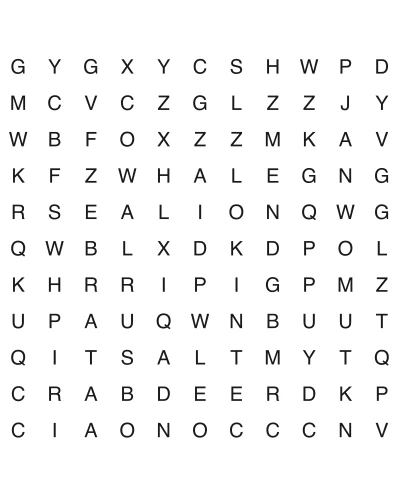
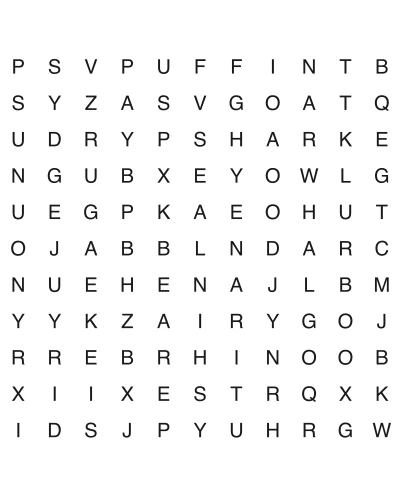
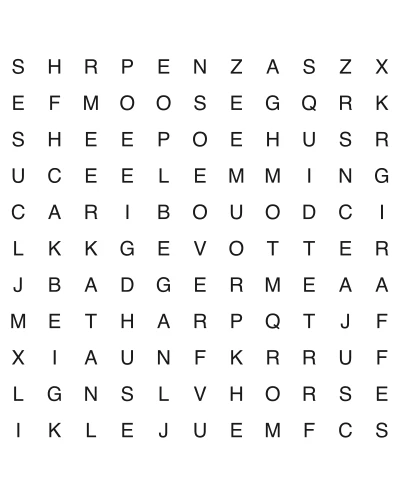
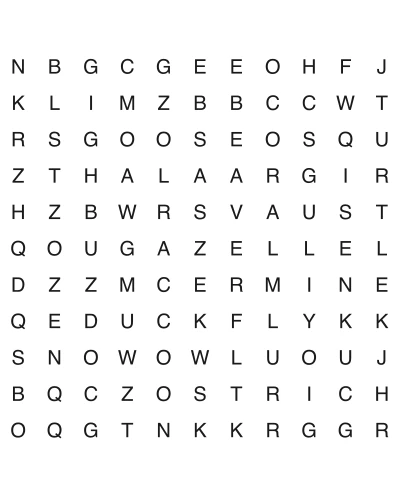
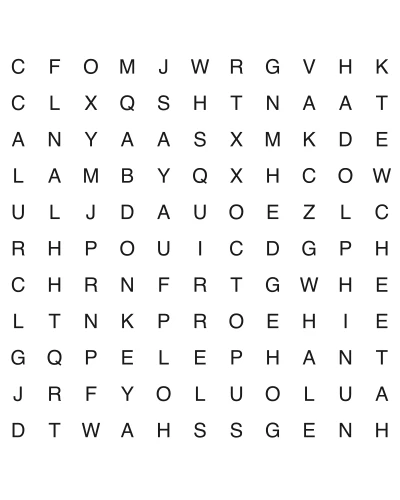
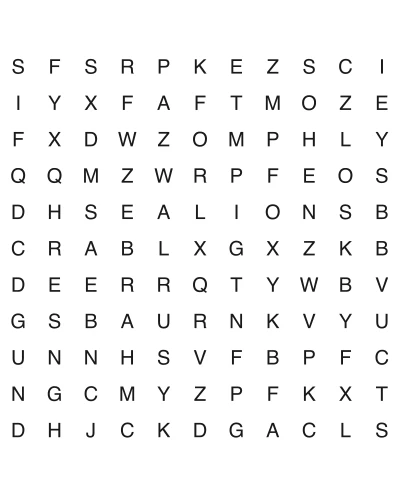
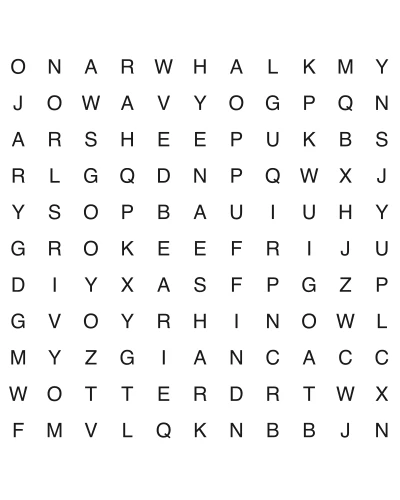
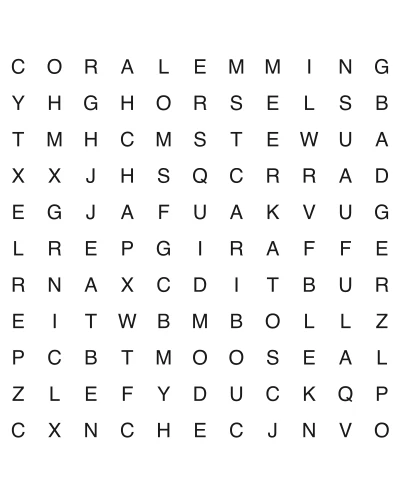
Animal word search puzzles you can print and hand over in under a minute — no account, no watermark, answer key on page two. The word lists are grouped by habitat, so a child hunting for ORCA and KELP in the ocean grid is quietly sorting animals into where they live. Pick 11x11 for a new reader (words run across and down only) or 18x18 for someone who wants all eight directions, including backwards.
How to download: Click any puzzle below to open the PDF (puzzle + answer key) in a new tab. Print on US Letter paper. No signup required.
At a glance
- Puzzles
- 12 free
- Format
- PDF (US Letter, 8.5×11 in)
- Grid
- 11 × 11
- Directions
- Across and down only
- Price
- Free, no signup
- License
- Personal & classroom use
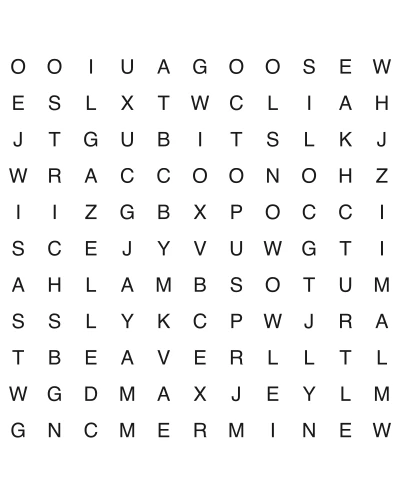
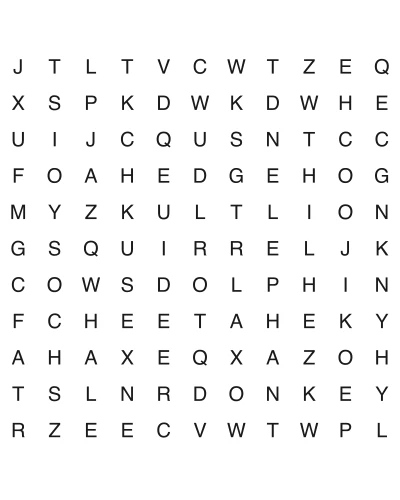
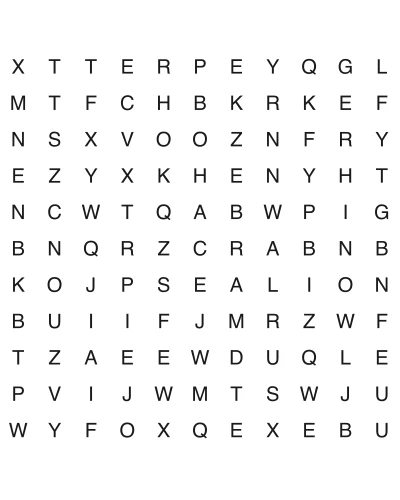
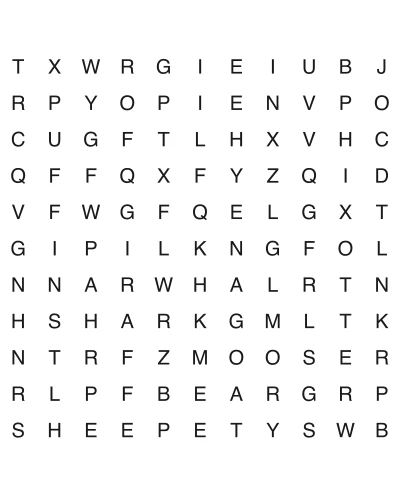
How to Play
Pick the grid before you pick the animals
Grid size, not vocabulary, is what children actually experience as difficulty — a word that is trivially findable in an 11x11 square becomes a needle in a haystack at 18x18, because the eye has roughly 2.7 times more letters to sweep. So we sort these by grid before anything else: For a classroom with mixed reading levels, print the 11x11 and the 15x15 of the *same* animal theme — everybody hunts the same animals and compares notes at the end, but nobody is stuck with a puzzle that is either insulting or impossible.
- •11x11, easy — words run horizontally and vertically only. Two directions. This is the version to print for a child who has only recently stopped sounding words out letter by letter. No backwards words, no diagonals, nothing hiding at an angle a new reader hasn't learned to scan for yet.
- •15x15, medium — adds both diagonals, so four directions. The usual jump for a second or third grader who has started finding the easy grids boring halfway down the word list.
- •18x18, hard — all eight directions, backwards included. Longer, less familiar species names. This is the one to print for an adult doing a puzzle with coffee, or for a kid who has genuinely outgrown the others.
The word lists are grouped by habitat, and that's doing work
Most animal word searches are a bag of animals: ELEPHANT next to PENGUIN next to COW, in whatever order they came out of the person's head. Ours are grouped — farm, ocean, rainforest, arctic, backyard — and each grid draws from a single habitat. That is a small design decision with a disproportionate payoff. A child working the arctic grid finds POLAR BEAR, WALRUS, SEAL, NARWHAL, PUFFIN, ARCTIC FOX. Nobody has told them these animals share a biome. But by the fourth word, the pattern has arrived on its own: everything on this page is white or grey, everything on this page lives where it is cold. That is classification, and it got in sideways while they were busy looking for letters. The habitat grouping also fixes a quieter problem. When the word list is mixed, a child who doesn't know what an OKAPI is just scans for O-K-A-P-I as a letter string and learns nothing. When the list is "rainforest," the unfamiliar name arrives with a context that makes a guess possible — and a guess is the thing you can actually correct. The backyard grid is deliberately the most ordinary one on the page: ROBIN, SQUIRREL, RABBIT, SNAIL, SPIDER, WORM. These are animals a child can go outside and verify, which is the whole reason it exists.
Some animal names are genuinely hard to hide in a grid
This is the part of puzzle construction nobody mentions, and it changes which animals you'll actually find on our grids. Three things make an animal name awkward to place: The upshot: a word list is not just a theme, it is a constraint satisfaction problem, and the puzzles that feel good to solve are the ones where no single word is a giveaway.
- •Length. HIPPOPOTAMUS is twelve letters. In an 11x11 grid it does not fit in any direction — there is no straight line of twelve cells. RHINOCEROS at ten letters fits, but only along a handful of rows, columns, or the two full diagonals, which means it lands in a predictable place and stops being a challenge. Long names are why the easy grids skew toward COW, PIG, FROG, OWL, BAT.
- •Repeated letters. GIRAFFE has a double F; RACCOON has a double C and a double O; HIPPO has a double P. Doubled letters create a visual stutter in the surrounding filler that a practiced solver spots instantly — a "FF" sitting in a field of random letters is a flare. Good construction scatters these rather than clustering them, so one grid does not end up with three double-letter animals all findable in four seconds.
- •Q, X, and Z. English animal names starve for these. QUAIL and QUOKKA are most of the Q list. The X ones are almost all fish and oddities — OX, LYNX, FOX, IBEX, AXOLOTL. Z gives you ZEBRA, ZEBU, and not much else. In a random filler alphabet, a Q or X or Z is so rare that it functions as a landmark: a solver who spots a lone X on the board will find FOX or LYNX within a second or two. We treat those three letters as a budget rather than free vocabulary, which is why you will not see six X-animals crammed into one 11x11 grid.
Print it the day before you need it
Three places these actually get used: The PDFs are US Letter, page one the puzzle and page two the answer key — print one or both, your call, and the file is small enough to email to a grandparent. The word search PDF page covers paper sizes, print settings and what is actually inside the file.
- •The zoo trip. Print the ocean and rainforest grids the night before. The long gap in the cafeteria at 1pm is the moment a parent will reach for anything, and kids who have just seen a real OTTER find the word OTTER with disproportionate enthusiasm.
- •The nature walk. The backyard grid is the companion to actually going outside. Do the walk first, then the puzzle — the words land differently when the child spotted a ROBIN forty minutes ago. If you want the walk itself documented, pair it with the reading log printable sheet format and let them write down what they saw.
- •The car. The 15x15 on a clipboard, one pencil, no screen, no battery. It is the single most reliable forty minutes of quiet available to a parent on a highway.
Age-appropriate word selection, honestly
A six-year-old knows COW and FROG. A six-year-old does not know OKAPI, PANGOLIN, or AXOLOTL, and putting those on a beginner grid does not teach them anything — it just converts a reading activity into a letter-matching chore, because they cannot hold a meaningless string in working memory while they scan. So the easy grids draw from a deliberately narrow pool: animals a child can picture. Three to five letters mostly, nothing they'd need to be told about. The medium grids introduce animals a child has probably seen in a book but not in person — TOUCAN, LEMUR, MANATEE. The hard grids are where the genuinely unfamiliar names live, and those are aimed at older kids and adults who will enjoy looking one up. One more thing worth saying plainly, because this page is aimed at classrooms: every grid is screened for accidental words in the filler before it ships, and re-rolled if one turns up — the easy word search page has the measured per-tier rates, which turn out to depend on grid size. If your animal fan is also a colorer, the animal coloring pages are the busiest thing on this site: cat coloring pages for adults for the detailed ones, cat coloring pages and kitten coloring pages for simpler outlines, and dinosaur coloring pages for the child who has decided dinosaurs are the only animals that count.
Frequently Asked Questions
What age are word searches good for?
Roughly ages 5 to 12, with the caveat that the format changes job at each end. A four- or five-year-old still learning to read can do these with an adult reading each word aloud first — at that stage it is letter recognition, not reading. By six or seven most children can read the word list themselves and work an 11x11 grid alone. Diagonals are the natural next step, which is why our 15x15 tier adds them.
How many words should a word search have for a younger child?
Five to ten words on a grid of about 10x10 to 12x12 is the usual recommendation for a six-year-old, and our easy tier sits in that band at 11x11. Ten-to-twelve-year-olds comfortably handle 12 to 18 words on a larger grid. The failure mode to avoid is a long word list on a small grid: the words end up overlapping so densely that the puzzle becomes unsolvable rather than hard.
Is there an answer key?
Yes. Every PDF is two pages: page one is the puzzle, page two is the answer key with every word marked. Print both, or print page one and keep the key on your phone — with a group, the key is what saves you from being asked where WALRUS is thirty times.
Can I print these for my whole class?
Yes — classroom and homeschool printing is exactly what these are for, and there is no per-copy limit. The one thing worth knowing before you run thirty copies: the grids are screened for accidental inappropriate words in the filler and re-rolled when one turns up, which matters more at classroom volume than at kitchen-table volume. The measured rates are on the easy word search page.
Will it print properly, or get cut off?
It prints properly, and you do not need to change any setting to get that — on either paper size. Print at 100% / "Actual size" on US Letter or on A4; the grid is laid out well inside what A4 can print, so nothing is lost at full size and shrinking it only costs you letter height. The word search PDF page has the exact geometry and the rest of the print-dialog settings.
Do word searches actually teach anything, or are they just busywork?
Honestly: a word search is not a reading-comprehension exercise, and anyone selling it as one is overselling. What it reliably does is spelling recognition and sustained visual attention — a child has to hold a target spelling in mind while sweeping a field of noise, which is a real and specific skill. Treat it as a good quiet activity doing slightly more than nothing, not as a lesson.
Why can't I find HIPPOPOTAMUS on the easy puzzle?
Because it does not fit. HIPPOPOTAMUS is twelve letters and an 11x11 grid has no straight run of twelve cells in any direction. Any animal name longer than the grid is a side is impossible to place, so the easy tier draws from shorter names and the long species names live on the 15x15 and 18x18 grids. If your child specifically wants HIPPOPOTAMUS, the medium grid is the smallest one that can hold it.
Are these free, and do I need an account?
Free, and no account. No email wall, no watermark, no "sign up to unlock the answer key." Click the download and you have the PDF.